MIKOLO Fitness · TRAINING Guide
Your back knee lowers toward the floor, your front leg does the work, and the Smith machine keeps the bar moving along a predictable path. That stability is the biggest advantage of Smith machine lunges.
Technically, what most lifters call a Smith machine lunge is closer to a stationary split squat because your feet stay planted throughout the set. You lose the stepping motion of a traditional lunge, but you gain a more controlled setup that makes it easier to focus on your legs, range of motion, and progressive overload.
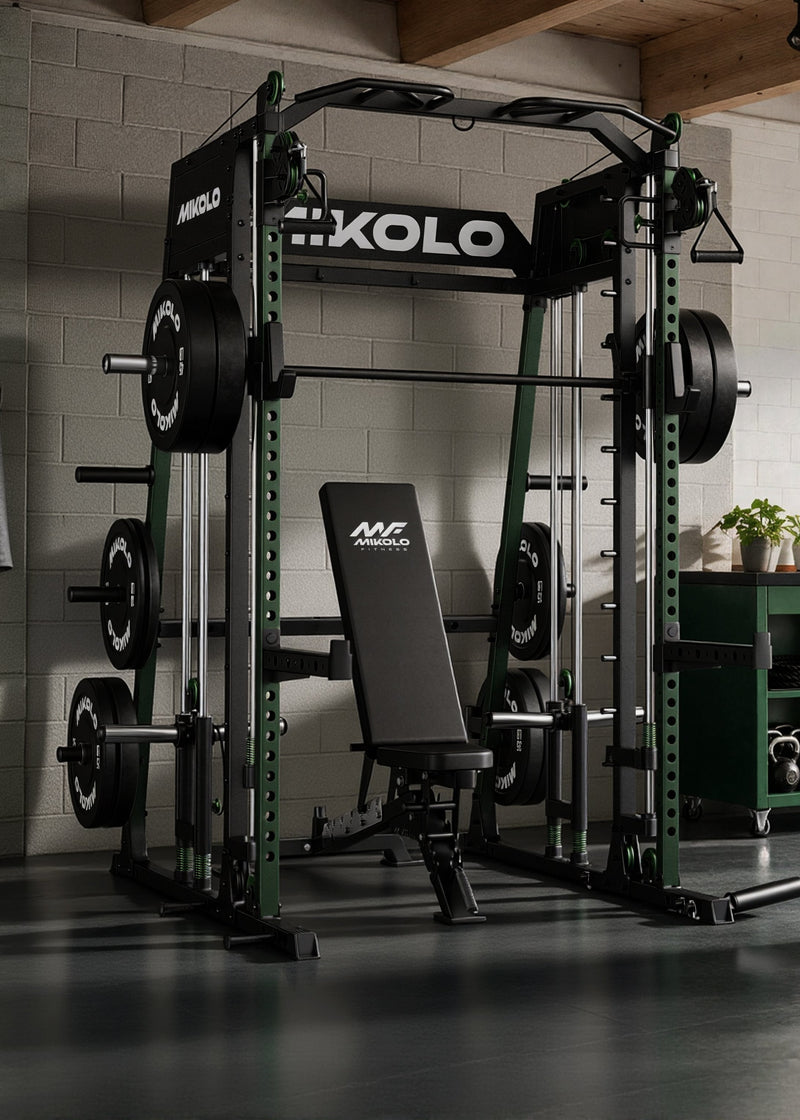
For home gym lifters, this can be especially useful when training alone. The guided bar path reduces balance demands, while the machine's safety catches provide an additional layer of protection when you're working with heavier loads.
Key Takeaways
- Smith machine lunges function more like stationary split squats because your feet stay planted.
- The fixed bar path reduces balance demands compared with free-weight lunges.
- Quads and glutes are the primary muscles trained, while stance length and torso angle can change the emphasis.
- Your front knee can naturally travel past your toes as long as the movement is controlled and comfortable.
- Start with a manageable load and increase resistance gradually as your technique improves.
What Is a Smith Machine Lunge?
A Smith machine lunge is a unilateral lower-body exercise performed with a barbell guided along fixed rails. You take a staggered stance, lower your body toward the floor, and drive back up through the front leg.
Unlike a traditional forward or walking lunge, you don't step between repetitions. Both feet remain in position, which makes the movement technically closer to a split squat.
Lunge vs. Split Squat
The distinction is simple:
| Movement |
Foot Position |
Main Difference |
| Traditional lunge |
Steps between reps |
Dynamic movement |
| Walking lunge |
Moves continuously |
Requires coordination and balance |
| Split squat |
Feet stay planted |
Stable unilateral movement |
| Smith machine lunge |
Feet stay planted |
Guided bar path adds stability |
In everyday gym language, "Smith machine lunge" is still a common and useful term. The important thing is understanding how the movement actually works so you can set it up correctly.
What Muscles Do Smith Machine Lunges Work?
Smith machine lunges primarily train the quadriceps and glutes. Your hamstrings, adductors, calves, and core also contribute to controlling the movement.
Quads and Glutes
Your quadriceps work to extend the front knee as you stand up. Your glutes contribute heavily to hip extension, particularly as you drive out of the bottom position.
Your stance and torso position can change the relative emphasis:
-
Shorter stance: Usually increases forward knee travel and places more demand on the quads.
-
Longer stance: Allows greater hip flexion and can increase the contribution of the glutes and hamstrings.
-
More upright torso: Generally favors a more knee-dominant movement.
-
Slight forward torso lean: Can increase the demand on the hips and glutes.
There is no single "perfect" stance for everyone. Your proportions, mobility, and training goal should determine your setup.
Supporting Muscles
Your hamstrings, adductors, and calves help stabilize and control the movement. Your rear leg provides support while your front leg handles most of the work.
Your core also plays an important role. Bracing your abs and obliques helps keep your torso controlled instead of allowing excessive twisting or movement under the bar.
How to Do Smith Machine Lunges
Good technique starts with a comfortable stance. Don't try to force yourself into an exact foot position if it makes your knees, hips, or ankles feel restricted.
1. Set Up Your Stance
Position the bar across your upper traps and unrack it using the Smith machine's normal safety procedure.
Step into a staggered stance with:
- Your front foot completely flat on the floor
- Your rear foot on the ball of the foot with the heel elevated
- Your feet roughly hip-width apart rather than directly behind one another
- Enough distance between your feet to allow both knees to bend comfortably
Take a few unloaded reps to find your natural stance before adding weight.
2. Lower Under Control
Brace your core and lower your body toward the floor.
Keep your front knee tracking generally in line with your toes. Your knee can move past your toes naturally; this isn't a problem when the movement is controlled and comfortable for your individual mobility.
Lower until your rear knee approaches the floor without crashing into it. Your torso can remain mostly upright or use a slight forward lean depending on your desired muscle emphasis.
3. Drive Back Up
Press through your entire front foot, keeping the heel and midfoot grounded.
Extend your front knee and hip to return to the starting position. Avoid bouncing out of the bottom or using momentum to complete the repetition.
Your goal should be a controlled descent, stable bottom position, and strong drive upward.
How to Bias Smith Machine Lunges for Quads or Glutes
Small changes in your setup can change where you feel the movement most.
For more quad emphasis:
- Use a slightly shorter stance.
- Allow natural forward knee travel.
- Keep your torso relatively upright.
- Use a controlled range of motion.
For more glute emphasis:
- Try a slightly longer stance.
- Allow more hip flexion at the bottom.
- Use a controlled, slight forward torso lean.
- Focus on driving through the front foot.
These are guidelines rather than strict rules. Your anatomy and mobility will influence how each setup feels.
Sets, Reps, and Progression
Smith machine lunges can work as a primary unilateral exercise or as part of a larger leg workout.
A simple starting point:
| Training Goal |
Sets |
Reps per Leg |
Load |
| Beginner |
2–3 |
8–12 |
Light |
| Strength & hypertrophy |
3–4 |
6–10 |
Moderate to heavy |
| Higher-rep training |
3 |
12–15 |
Light to moderate |
Choose a weight that allows you to maintain consistent technique on both legs. You don't need to increase the load every workout.
A practical progression strategy is to add a small amount of weight—or an extra rep—when you can complete all your target sets with clean form while keeping roughly 1–2 reps in reserve.
If your technique breaks down before you reach your target reps, keep the same weight or reduce it.
"If your technique breaks down before you reach your target reps, keep the same weight or reduce it."
Smith Machine Lunges vs. Dumbbell Lunges
Both variations are effective, but they place different demands on the lifter.
| Feature |
Smith Machine Lunge |
Dumbbell Lunge |
| Balance demand |
Lower |
Higher |
| Bar path |
Fixed |
Free |
| Movement |
Stationary |
Static, stepping, or walking |
| Loading |
Bar on shoulders |
Weights held at sides |
| Grip limitation |
Minimal |
Can limit heavier sets |
| Stability |
Machine-assisted |
Self-stabilized |
| Best suited for |
Controlled loading and muscle focus |
Balance, coordination, and movement freedom |
If your main goal is to load one leg heavily without letting balance become the limiting factor, the Smith machine is a strong option.
If you want to develop more dynamic movement and coordination, dumbbell lunges offer greater freedom.
Smith Machine Lunge Variations
You can change the exercise without completely changing your equipment setup.
Smith Machine Bulgarian Split Squat
Place your rear foot on a bench or elevated surface. This increases the range of motion and can place more demand on the front leg.
Because the setup is more demanding, start with a lighter load and make sure you can maintain control throughout the movement.
Smith Machine Reverse Lunge
A reverse lunge involves stepping the working leg back rather than forward. For lifters who prefer less forward knee travel, this variation can provide a comfortable alternative.
Free-Weight Walking Lunge
Walking lunges require you to move through space, so they cannot be replicated exactly on a fixed Smith machine bar. Use dumbbells, kettlebells, or a free barbell instead.
For more setup progressions and technique cues, see the guide for the Smith machine lunge.
Common Smith Machine Lunge Mistakes
Letting the Knee Collapse Inward
Your front knee should generally track in the same direction as your toes. Avoid allowing it to collapse inward as you descend or stand up.
Lifting the Front Heel
Your front foot should remain firmly planted. If your heel repeatedly lifts, adjust your stance or reduce the range of motion until you can maintain stable foot pressure.
Using Too Much Weight
The Smith machine makes heavy loading easier, but that doesn't mean heavier is always better. If you lose control, shorten your range of motion, or rely on momentum, reduce the load.
Rushing the Descent
A controlled eccentric phase helps you maintain position and control. Lower smoothly instead of dropping quickly into the bottom.
Frequently Asked Questions
Should Your Knee Go Past Your Toes During a Smith Machine Lunge? ▼
Yes. Your front knee can naturally move past your toes when you have the mobility to do so and can maintain control. The important factors are comfortable movement, stable foot pressure, and consistent knee tracking.
How Much Weight Should You Start With? ▼
Start with the unloaded Smith machine bar and use it to establish your stance and technique. Smith machine starting resistance varies by model, so don't assume every machine has the same bar weight. Once your setup feels natural, add a small amount of resistance and progress gradually.
Where Should Your Feet Be on a Smith Machine Lunge? ▼
Your front foot should be fully planted, with your rear foot behind you on the ball of the foot. Keep your feet roughly hip-width apart rather than placing them directly in a straight line. The ideal front-to-back distance depends on your leg length, mobility, and preferred muscle emphasis.
Can You Do Walking Lunges on a Smith Machine? ▼
Not in the traditional sense. A Smith machine keeps the bar on a fixed track, while walking lunges require you to move forward through space. Use dumbbells, kettlebells, or a free barbell for walking lunges.
Are Smith Machine Lunges Good for Glute Growth? ▼
Yes. Smith machine lunges can provide substantial glute training, particularly when you use a stance that allows sufficient hip flexion and maintain a controlled range of motion. A slightly longer stance and a modest forward torso lean can increase the relative contribution of the glutes.
Final Takeaway
Smith machine lunges offer a practical way to train one leg at a time while reducing the balance demands of free-weight lunges. The fixed bar path allows you to focus on stance, range of motion, and progressive overload instead of constantly managing the bar's movement.
Whether you want to build stronger quads, grow your glutes, or address side-to-side strength differences, this exercise can earn a place in a well-rounded home leg workout.
"Find a stance that feels natural, control every rep, and add weight only when your technique is ready for it."





















Leave a comment
This site is protected by hCaptcha and the hCaptcha Privacy Policy and Terms of Service apply.